Look How Far
Behaviour log: five lines after an episode
A behaviour log for meltdowns and other hard moments: the five lines from our note “Meltdown vs tantrum”, as a sheet for the fridge door — two episodes per page, written when things are calm.
PDF, US Letter52 KBPDF, A453 KB
1 page · black and white · no sign-up
Why it helps
During an episode you are busy keeping everyone safe, not observing. Five lines written afterwards — the same evening or the next morning — are enough to see, over a few weeks, whether episodes follow a long, loud day or a “no”. There is a place for the date you wrote the entry, because it is often not the day it happened.
What is on the sheet
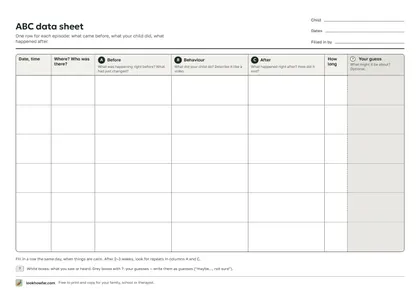
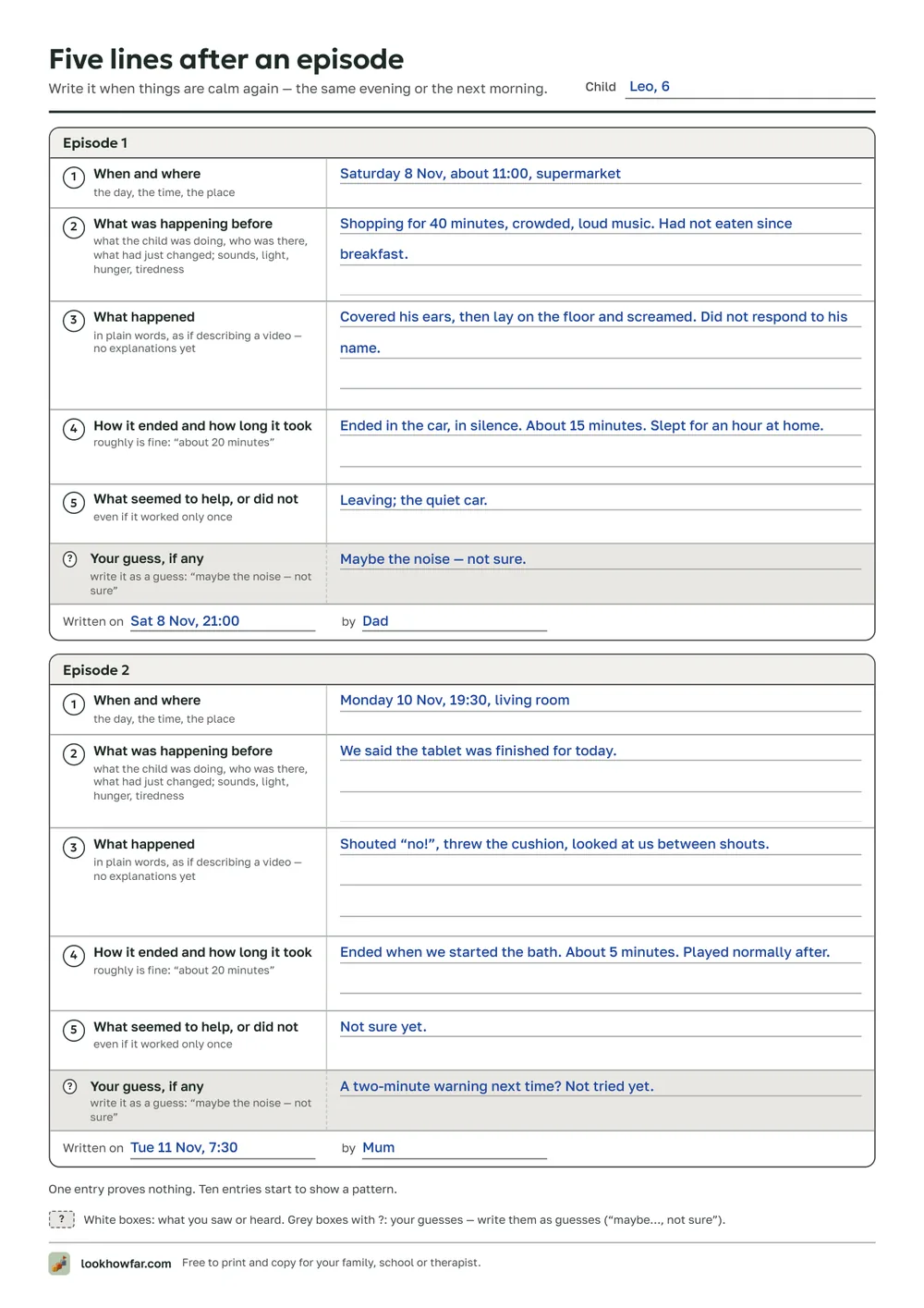
One page with two episodes. Each has five numbered lines — when and where, what was happening before, what happened, how it ended and how long it took, what seemed to help — then a grey line for your guess, and the date you wrote it and who wrote it.
How to use the behaviour log
- When things are calm, write the day, the time and the place.
- Write what was happening before, then what happened — as if describing a video.
- Write how it ended, roughly how long it took, and what seemed to help.
- If you have a guess, put it in the grey box as a guess. Add when you wrote the entry and who wrote it.
White boxes are for what you saw. Grey boxes with ? are for guesses. A fact is not a guess — the same rule as in our notes, and in Look How Far.
When to show it to a specialist
When you have ten or more entries, or something new or worrying appears, take the sheets to your child’s doctor or specialist. A short summary with dates and two or three examples is easier to discuss than a stack of pages. If someone is in danger, deal with that first — the notes can wait.
Questions parents ask
What should a behaviour log include?
When and where it happened, what was happening before, what your child did, how it ended and how long it took, and what helped. Keep guesses separate from what you saw.
Should I write it during the meltdown?
No. During an episode, keep everyone safe. Write it afterwards — the same evening or the next morning — and note the date you wrote it.
How is this different from a meltdown tracker app?
It is paper: no account, no phone in your hand during a hard moment. If you prefer to say it out loud, Look How Far keeps the same five lines from your voice.
When will I see a pattern?
Often after ten or more entries, over two to four weeks. Read them together and look at what came before and what helped.
These sheets are for observations. They do not diagnose and do not replace your child’s doctor or specialist.