Look How Far
Feelings thermometer
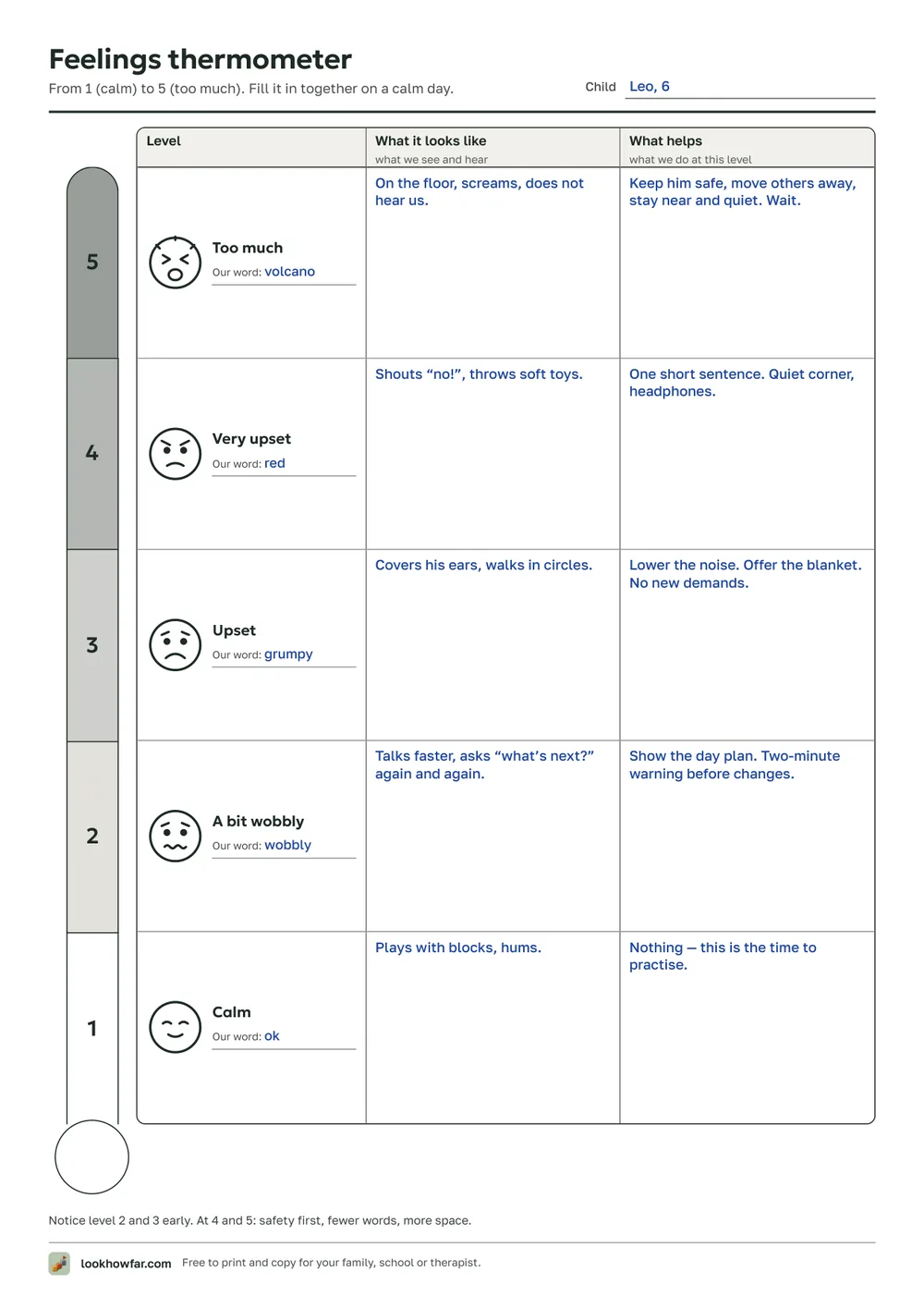
A feelings thermometer from 1 (calm) to 5 (too much). For each level you write what it looks like in your child and what helps — so everyone can notice the rise early, before level 5.
PDF, US Letter38 KBPDF, A438 KB
1 page · black and white · no sign-up
Why it helps
Hard moments rarely come from nowhere: there is usually a climb — faster talk, more questions, covered ears. A thermometer turns that climb into numbers your child, you and the school can share. What helps at 2 (a heads-up, a quiet minute) is very different from what helps at 5 (keeping everyone safe and waiting).
What is on the sheet
One page: a thermometer with five levels, a face and a name for each level with a line for your child’s own word, and two columns — what it looks like, and what helps. Grey shading gets darker towards 5 and prints well in black and white.
How to fill in a feelings thermometer
- Fill it in together on a calm day, never in the middle of a hard moment.
- Start from 1: what does calm look like? Then 5: what does “too much” look like? Then fill in 2, 3 and 4.
- Write what you can see and hear, not labels: “talks faster, repeats the question”, not “gets difficult”.
- In “What helps”, write what has actually helped before. At 4 and 5, keep it short: safety, space, fewer words.
When to show it to a specialist
Share the thermometer with the school, so the same words are used in both places. If level 4 and 5 moments become more frequent, longer, or someone gets hurt, talk to your child’s doctor or specialist and bring the thermometer and a few weeks of notes. Safety comes first.
Questions parents ask
What is a feelings thermometer?
A picture of a thermometer split into levels, usually 1 to 5, from calm to overwhelmed. Children and adults use it to say how strong a feeling is and to agree what helps at each level.
Is it the same as an anger thermometer?
It works the same way. An anger thermometer is about anger only; a feelings thermometer can be used for worry, upset or overload too. You can write “angry” or “worried” at the top of the sheet.
How do I use it in the moment?
Point and ask “which number?” only at low levels. At 4 or 5, do not ask — use the plan you wrote for that level.
Is it the same as the Zones of Regulation?
No. The Zones of Regulation is a separate, published programme with four coloured zones. This sheet is a simple 1–5 scale for families; if your child’s school uses another system, use their words at home.
These sheets are for observations. They do not diagnose and do not replace your child’s doctor or specialist.