Look How Far
Social story template
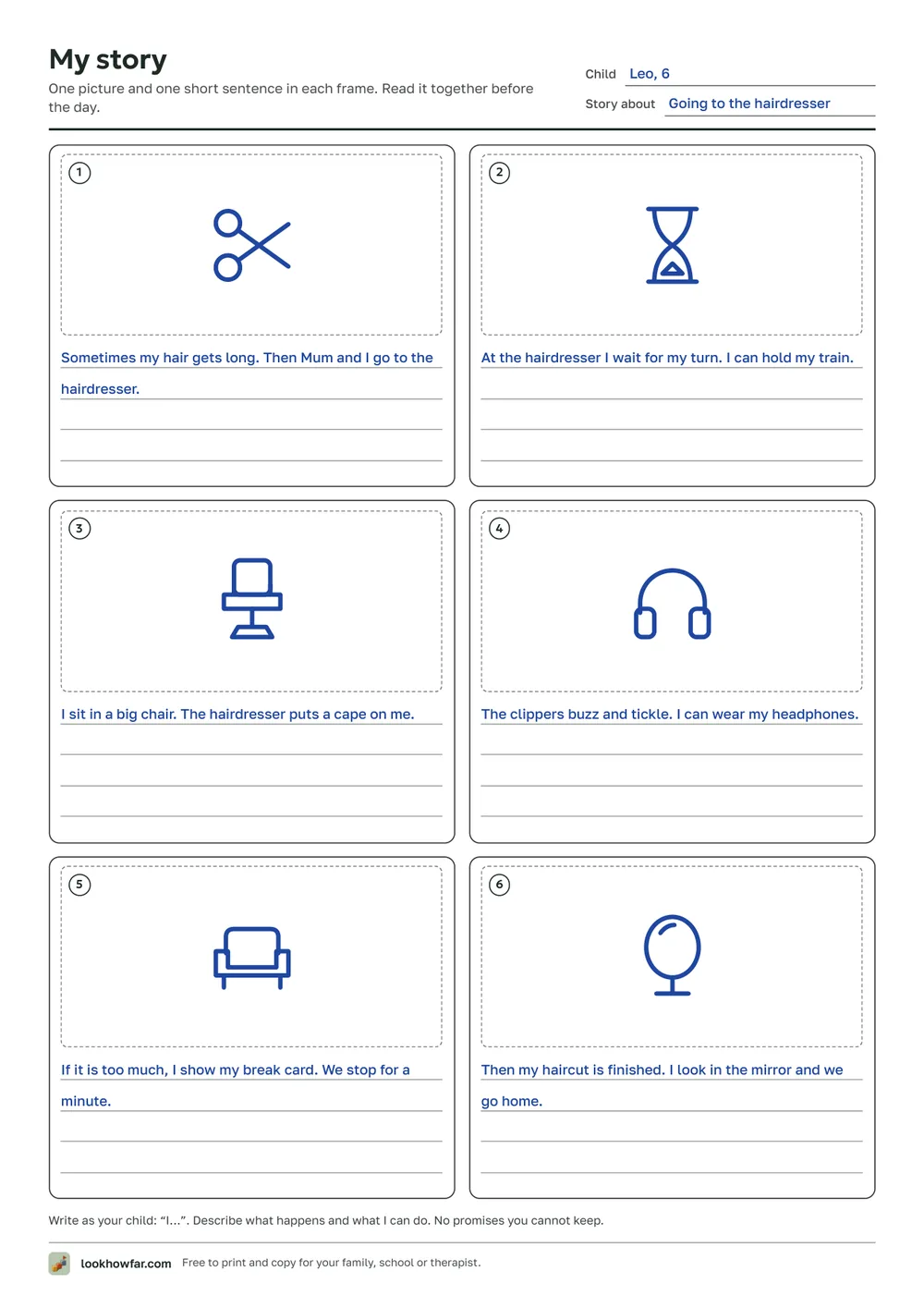
A social story template with six frames: a picture and a short sentence in each, to tell your child step by step what will happen — at the hairdresser, the doctor, a new school — before it happens. With a finished example about a haircut.
PDF, US Letter75 KBPDF, A474 KB
1 page · black and white · no sign-up
Why it helps
Many autistic children find new or rare situations hard because they cannot predict them: the noise of the clippers, the cape, a stranger touching their hair. A short story read a few times before the day turns the unknown into something they have already “seen”. Good stories describe calmly what happens and what the child can do — they do not tell the child how to feel.
What is on the sheet
One page: a line for what the story is about, and six numbered frames, each with an empty box for a picture or photo and three lines for a sentence. The example shows a fictional child’s story about going to the hairdresser.
How to write a social story
- Pick one situation and walk through it in your head, step by step, as your child will see, hear and feel it.
- Write one short sentence per frame, from your child’s point of view: “I sit in a big chair.” Describe more than you instruct.
- Add what your child can do if it gets hard: “I can show my break card.” Avoid promises you cannot keep.
- Draw, print or photograph a picture for each frame. Read the story together a few times in the days before — and on the day.
When to show it to a specialist
If the same situation stays very hard — the dentist, a blood test, a new school — ask your child’s teacher, speech and language therapist or psychologist to help you write the story; they may also know how your child reacts to similar places. For medical visits, tell the clinic in advance: many can offer a quiet room or the first appointment of the day.
Questions parents ask
What is a social story?
A short, simple story that describes a situation from the child’s point of view: what happens, what others do and what the child can do. Carol Gray first described Social Stories™ with their own detailed criteria; this template is a simple version for families.
How long should a social story be?
Short — four to eight sentences, one per page or frame. The younger the child, the shorter the story.
When should we read it?
A few times in the days before the event, at a calm moment, and once more just before. Keep it after the event too: many children like to read it again.
Photos or drawings?
Photos of the real place and people work best for many children — look for them on the website of the hairdresser, school or clinic. Simple drawings work too.
These sheets are for observations. They do not diagnose and do not replace your child’s doctor or specialist.