Look How Far
Communication board for autism
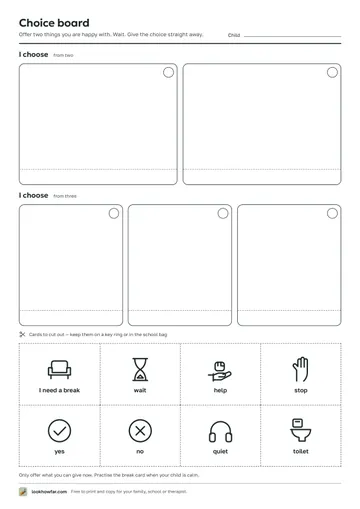
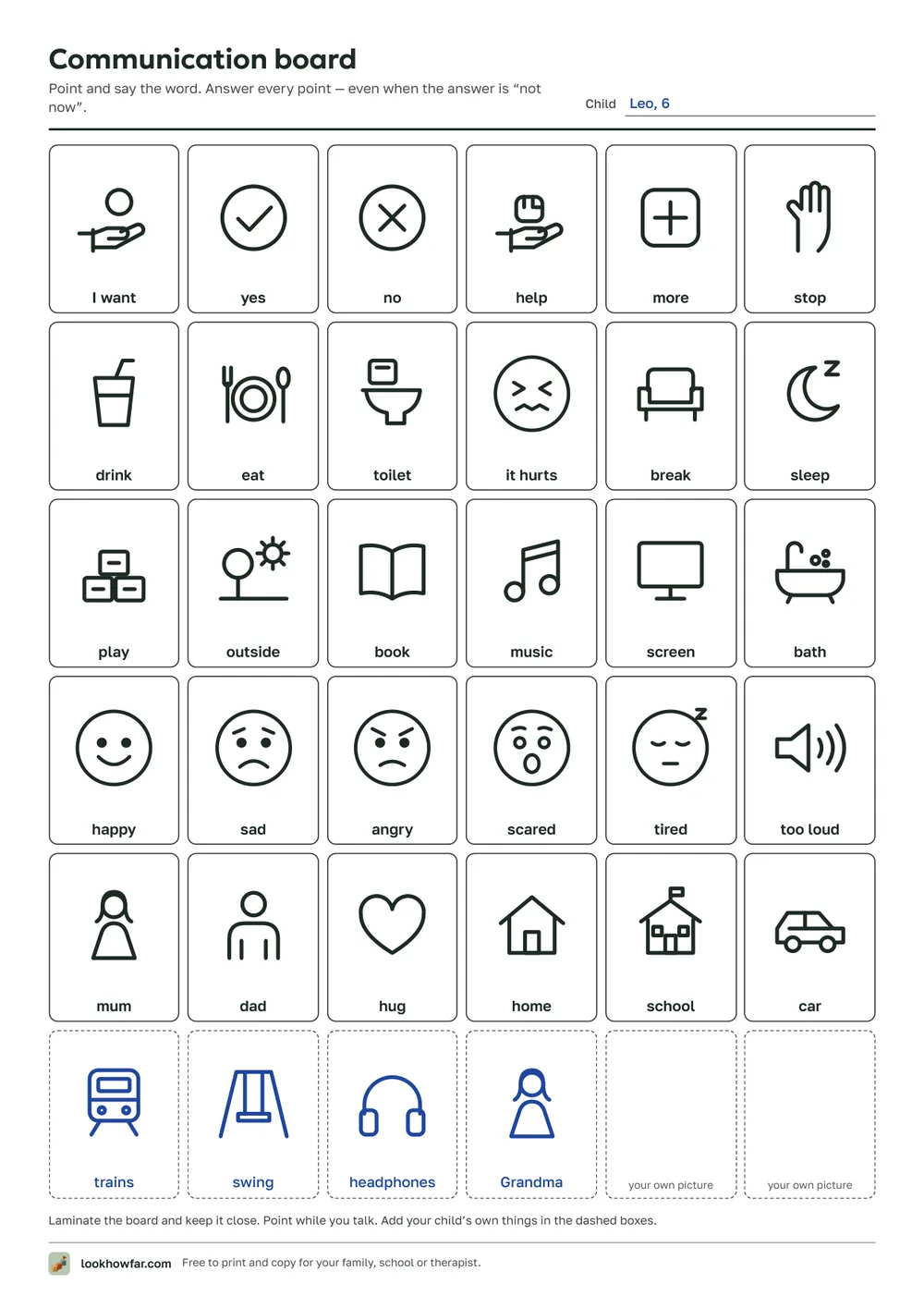
A communication board with 30 simple pictures your child can point at — “I want”, “yes”, “no”, “help”, “stop”, “drink”, “toilet”, “it hurts”, “break” — and six empty boxes for the words that matter in your home.
PDF, US Letter105 KBPDF, A4105 KB
1 page · black and white · no sign-up
Why it helps
A child who cannot say “I want a drink” or “it hurts” in the moment often shows it another way — crying, pulling you, a meltdown. Pointing at a picture gives them a faster way to be understood. Using pictures does not stop speech from developing; many children talk more when they are understood more.
What is on the sheet
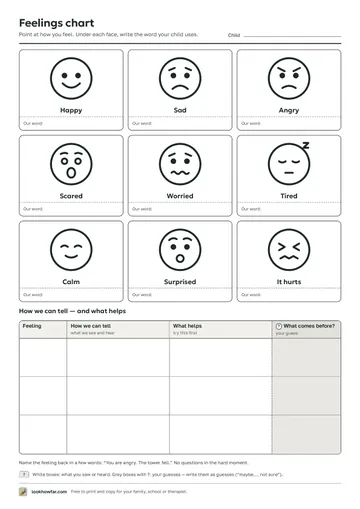
One page: 30 pictures in five rows — talking (I want, yes, no, help, more, stop), needs (drink, eat, toilet, it hurts, break, sleep), doing (play, outside, book, music, screen, bath), feelings (happy, sad, angry, scared, tired, too loud) and people and places (mum, dad, hug, home, school, car) — and a row of six dashed boxes for your own pictures. All pictures are our own plain line drawings and print well in black and white.
How to use a communication board at home
- Print the board, laminate it if you can, and keep it where your child spends time — on the fridge, the table, in the car.
- Use it yourself first: point while you talk. “You want… drink?” Point at “I want”, then at “drink”.
- Answer every point straight away, even if you cannot say yes. “Outside — not now. First lunch, then outside.”
- Fill in the six empty boxes with your child’s own things: a favourite toy, a person, a food — drawn, cut from a box or photographed.
When to show it to a specialist
A speech and language therapist can help you choose the words, the size of the pictures and how many to show, and can tell you about other options — picture exchange, a book of pictures, a speech app or device. If your child already uses symbols at school, use the same ones at home. A board is a support for communication; it does not replace therapy.
Questions parents ask
What is a communication board?
A sheet or board with pictures and words that a child points at to say what they want, need or feel. It is a simple form of AAC — augmentative and alternative communication — and needs no batteries.
Will a communication board stop my child from talking?
No. Research on AAC has not found that pictures hold speech back; many children say more words when they have a quick way to be understood. Say the word out loud each time you or your child point.
How many pictures should we start with?
Some children start with two or three — “I want”, “drink”, “help” — cut out from this board. Others can use all 30. Start with what your child needs most often and add more when it works.
Is this the same as PECS?
No. PECS is a published programme in which a child hands over a picture card, taught step by step. This board is for pointing. If your child learns PECS with a therapist, follow their plan and use this sheet only if they agree.
These sheets are for observations. They do not diagnose and do not replace your child’s doctor or specialist.