Look How Far
Toilet training chart
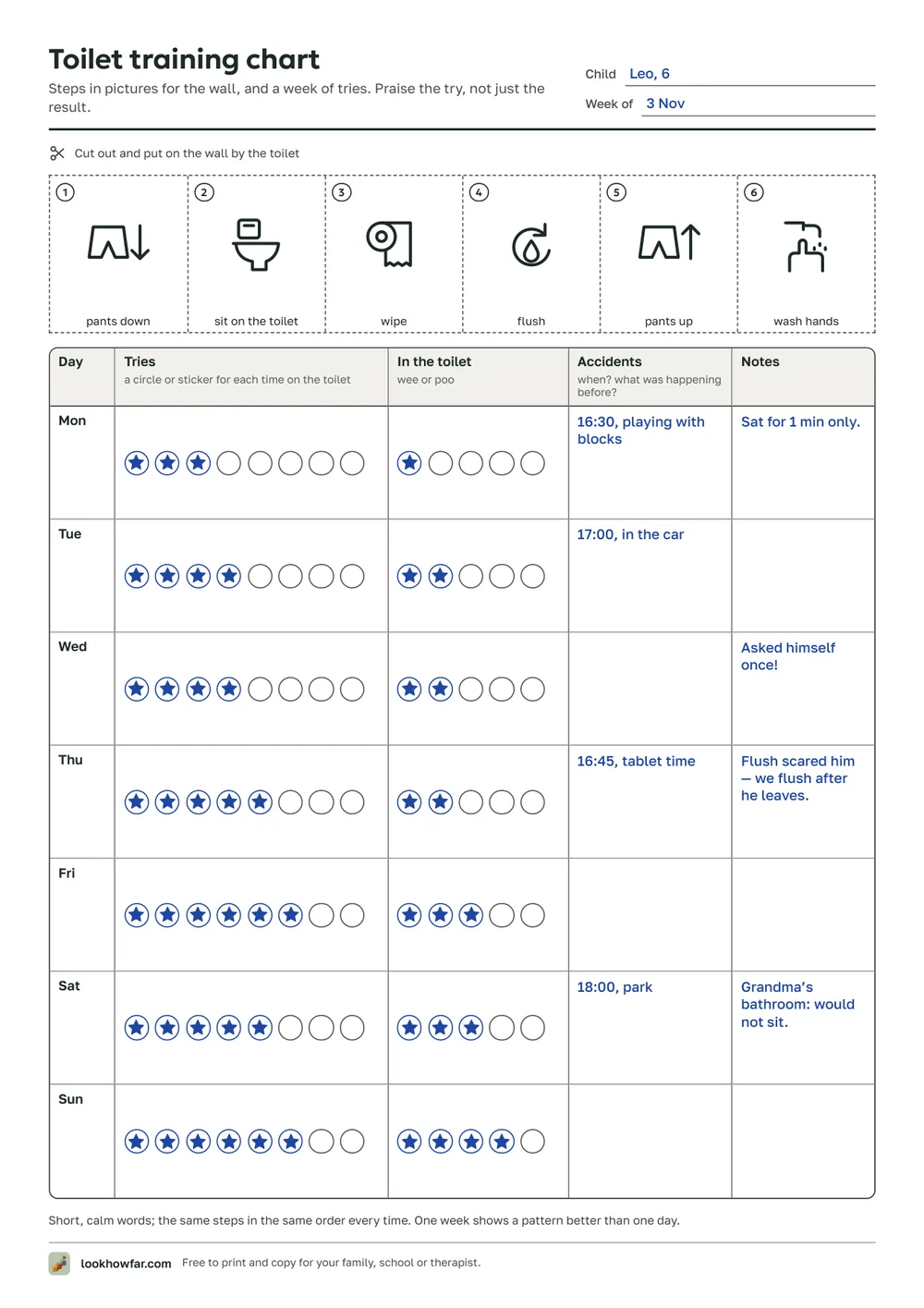
A toilet training chart in two parts: six steps in pictures to cut out and put on the wall by the toilet, and a week of tries, successes and accidents — with what was happening before each accident.
PDF, US Letter87 KBPDF, A488 KB
1 page · black and white · no sign-up
Why it helps
Many autistic children learn to use the toilet later and in smaller steps, and that is common. Two things often help: seeing the steps in the same order every time, and a record that shows progress you might not notice day to day — more tries, fewer accidents, an accident always at the same time or place.
What is on the sheet
One page: a strip of six numbered steps (pants down, sit on the toilet, wipe, flush, pants up, wash hands) with a cutting line, and a weekly table with one row per day — eight circles for tries, five for successes, and space for accidents and notes.
How to use the potty training chart
- Cut out the six steps and put them on the wall at your child’s eye level, next to the toilet.
- Each time your child sits on the toilet, colour a circle or add a sticker in “Tries”. Praise the try, not just the result.
- When a wee or poo goes in the toilet, mark it in “In the toilet”.
- For accidents, write the time and what was happening just before. After a week, look for a pattern.
When to show it to a specialist
Talk to your child’s doctor if toileting hurts, if there is constipation, blood or very hard stools, if a child who was dry starts having accidents again, or if there is no progress after several months. Bring the chart: a few weeks of records make the conversation easier. An occupational therapist can help with sensory difficulties around the toilet.
Questions parents ask
When should an autistic child be toilet trained?
There is no fixed age. Many autistic children are ready later than other children, and some learn in steps — wee first, poo later, nights much later. Readiness signs: staying dry for an hour or two, noticing a wet nappy, interest in the toilet.
Stickers or ticks?
Whatever your child likes. Some children love stickers; for others a tick is enough. If your child does not care about either, use the chart for yourself as a record.
What if my child is afraid of the toilet?
Fear of the flush, the noise or the hand dryer is common. Go step by step: sit dressed first, flush after leaving, use a step and a smaller seat. If the fear is strong, an occupational therapist can help.
Do I need to write down accidents?
Briefly, yes: the time and what was happening before. A week of notes often shows a pattern — after drinking, before leaving the house, during a favourite game — that is easier to plan for.
These sheets are for observations. They do not diagnose and do not replace your child’s doctor or specialist.