Look How Far
IEP parent input form
An IEP parent input form you fill in before a school meeting — an IEP, a 504 plan, an EHCP review or a simple meeting with the teacher: strengths, facts from home, worries, what helps and your questions, plus a table for what was agreed.
PDF, US Letter45 KBPDF, A445 KB
1 page · black and white · no sign-up
Why it helps
School meetings are short and full of people and papers. Parents often remember the most important thing on the way home. One page written calmly in advance — with facts rather than impressions — keeps the meeting on what matters to your child, and the “agreed” table makes it clear who does what afterwards.
What is on the sheet
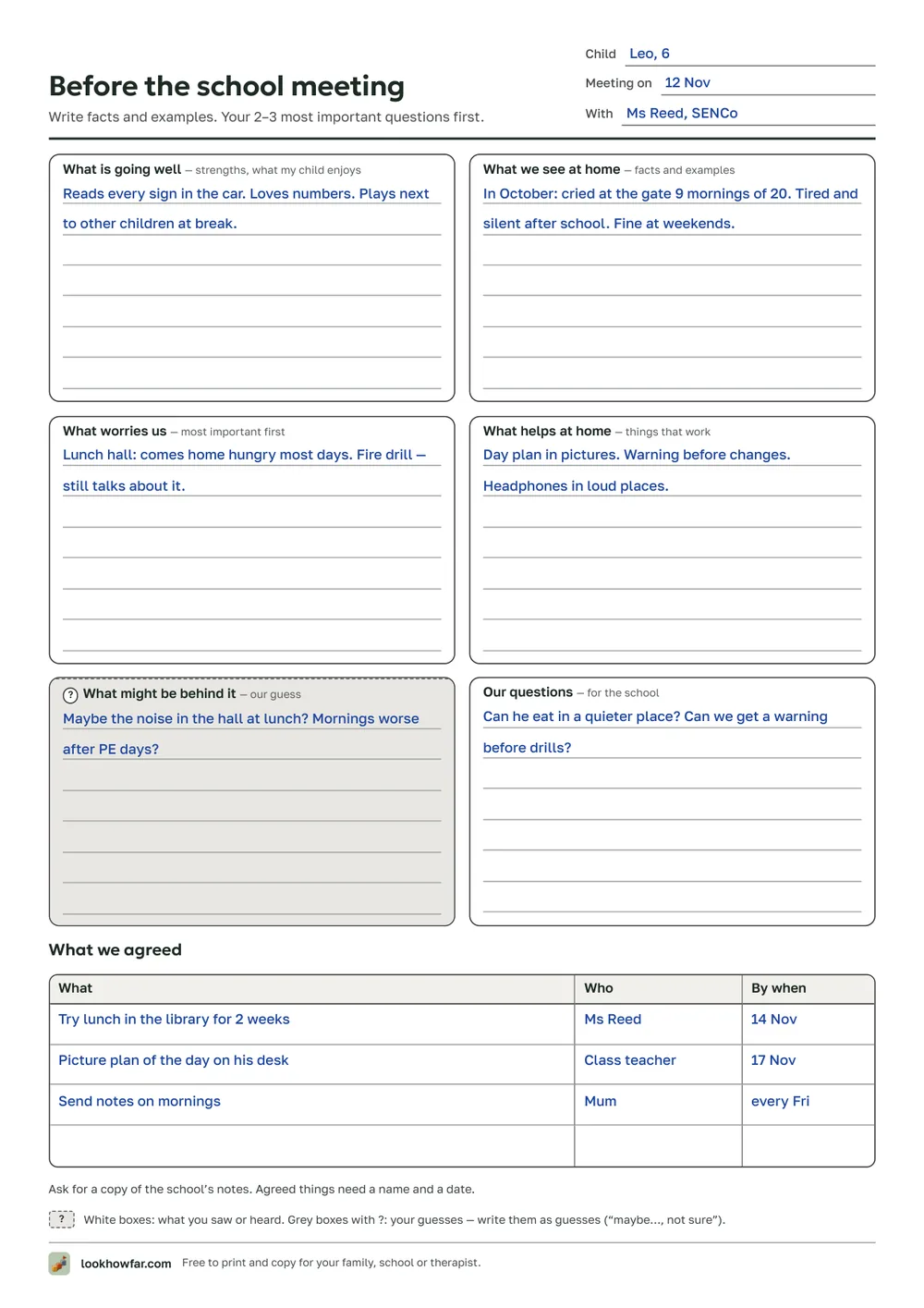
One page: six boxes — what is going well, what we see at home, what worries us, what helps at home, a grey box for what we think might be behind it, our questions — and a table for what was agreed, who does it and by when.
How to fill in the parent input form
- Fill it in a few days before the meeting. Look at your notes, logs and the school’s messages from the last weeks.
- Write facts with examples: “cried every morning at the school gate in October”, not “hates school”. Keep guesses in the grey box.
- Choose your two or three most important questions and put them first.
- During the meeting, fill in what was agreed: what, who, by when. Ask for a copy of the school’s notes too.
When to show it to a specialist
Bring a copy for everyone at the meeting, and attach any reports you are happy to share. Every country has its own system — IEP and 504 plans in the US, SEN support and EHCP in the UK, the EMAEI and the technical-pedagogical report in Portugal, PEI in Brazil — ask the school which applies to your child and what your rights are. This page works with all of them.
Questions parents ask
What is parent input in an IEP?
Your view of your child: strengths, needs, what you see at home and what you hope for. In the US, the IEP includes a section for parent concerns; writing them down in advance helps them get there.
Do I need a diagnosis for a school meeting?
Not always. Many schools offer support based on needs, before or without a diagnosis. Ask what is possible where you live.
What should I bring to the meeting?
This page, a few weeks of notes or logs if you keep them, any reports you are happy to share, and a list of questions. Bringing someone with you is fine too.
What if we do not agree?
Write down what was said and what you asked for, and ask for the decision and the reasons in writing. Each country has its own steps for disagreements.
These sheets are for observations. They do not diagnose and do not replace your child’s doctor or specialist.